
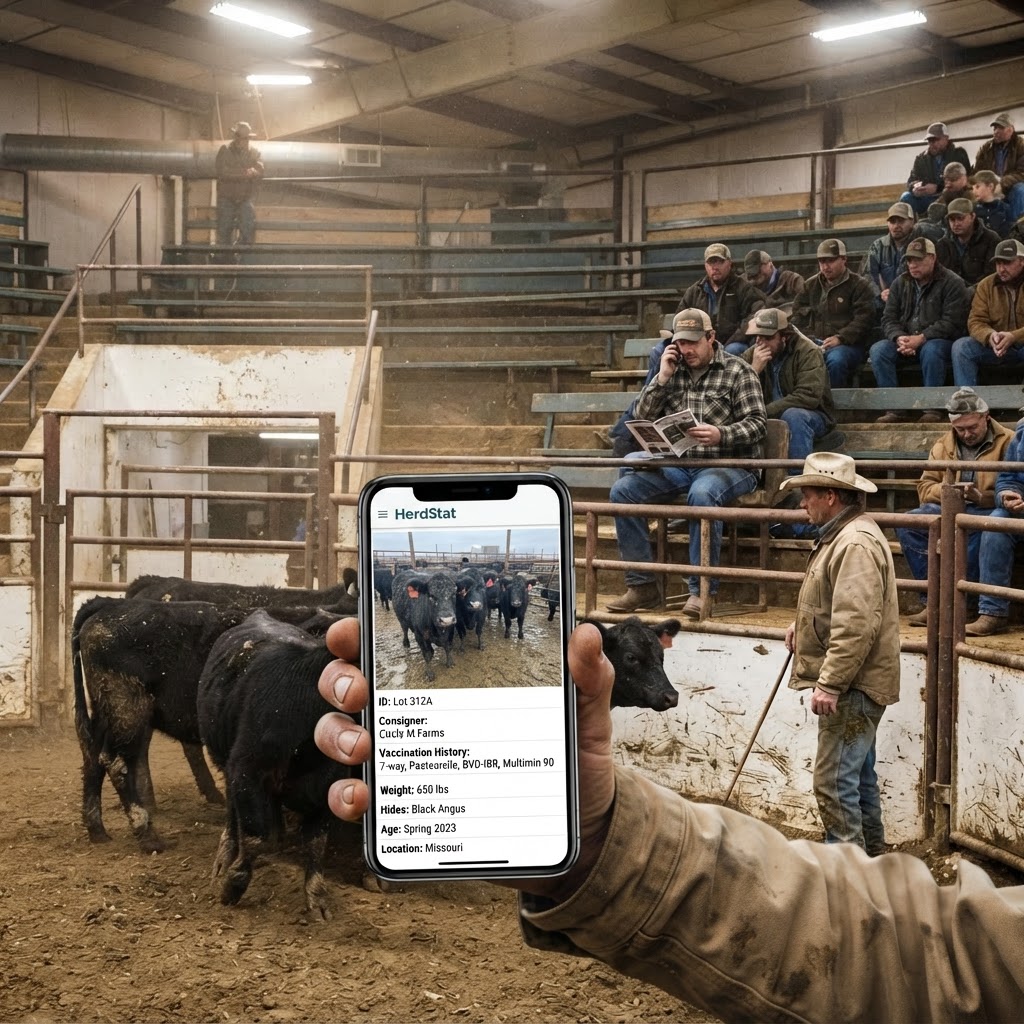
A buyer in Nebraska is bidding by phone on a run of bred heifers coming out of Missouri next week. He has never seen the operation, never met the consignor, and the only thing standing between him and a decision is a single line on a catalog PDF: "42 hd blk bred hfrs, bred Angus, due Mar." He wants to see the cows move. He wants the health program, the breeding dates, maybe thirty seconds of video showing them walking across a pasture. He opens the sale barn's website, clicks through to the catalog, and finds exactly what he started with: a PDF, a page number, a weight range. Sale day is three days out and he still cannot picture what he is bidding on.
Should Every Consignment Really Have Its Own Web Page?
Quick answer: Yes, when the page can be generated automatically from catalog data the barn already collects. A dedicated page per consignment lets buyers preview specific cattle before sale day, gives consignors real visibility for good cattle instead of a one-line entry, and creates searchable content a catalog PDF never will. The barrier was always labor, not value.
Why a Single Catalog Line Undersells a Good Consignment
A catalog line was built to fit a page, not to describe an animal. It gives weight, breed, sex, maybe a frame score, and nothing else, because that is all the format allows. Buyers who cannot travel to see cattle in person before sale day are left guessing at everything the line leaves out: how the group was developed, what vaccination program they ran, whether they were synchronized or exposed naturally, what the ground and feed looked like where they came from. That gap does not just slow down bidding, it caps it. A buyer who cannot verify quality bids like someone who is unsure, and unsure buyers protect themselves with lower numbers.
Consignors feel the other half of this gap. A producer who spent a year building a tight, well-managed load watches that work reduced to the same dozen words given to a load thrown together the week before. There is no way for the barn to show the difference between a casual consignment and a serious one when both get identical treatment on the page, and the consignors with the best cattle are the ones most likely to notice.
What a Real Consignment Page Gives Buyers and Consignors
A consignment page earns its keep by answering the questions a buyer would ask in person, before that buyer ever picks up a phone. It replaces guesswork with specifics, and it can do that job for every load in the sale, not just the ones chosen for the sale bill cover.
The elements that make a page genuinely useful are consistent across species and sale types:
- A short video or photo set showing the cattle in motion or at rest
- Accurate weights, breed composition, and age or calving information
- Health and management history: vaccination program, weaning date, breeding method
- Origin, including the operation, region, and how long the group has been managed together
- Delivery or hauling terms, and who to contact with questions before the sale
None of this is exotic information. Most of it already lives in the intake form a consignor fills out when they bring or ship a load to the barn. The difference between a catalog line and a real page is not better information, it is simply more of the information the barn already has, organized so a buyer can act on it instead of guess at it.
The Reason Barns Never Did This: 500 Pages by Hand
The barrier was never that barns failed to see the value of a dedicated page. It was that no office has the staff to build one by hand for every load in a 500-head sale, especially when half those loads are still being finalized the day before. A catalog office already runs flat out confirming weights, assigning lot numbers, laying out the sale bill, and fielding last-minute calls from consignors adding or pulling cattle. Asking that same office to also write copy, choose photos, and publish a dedicated page for every single load is not a design problem. It is a staffing problem no amount of design taste solves.
That is why dedicated pages historically went to a handful of marquee consignments, the ones with a professional photo already on hand or a consignor willing to write a description. Everything else got the one-line treatment, not because it deserved less, but because there was no time left to give it more.
Pages That Build Themselves From Your Catalog
The fix is not more staff hours, it is removing the hand-building step entirely. When a consignment page generates automatically from the same catalog data the barn already enters, weights, breed, health notes, consignor contact, there is no second round of data entry and no bottleneck waiting on someone to write copy for load number 340. The page exists as soon as the consignment is accepted into the catalog, and it updates when the catalog does.
This is the specific labor problem HerdStat was built to solve. Producers submit their consignment details and media once, through a single intake form, and that information flows into organized records, a sale sheet entry, and a standalone buyer-facing page, including an automatically generated promotional video where media is available. Nobody on staff writes a page from scratch, because the page was never the extra task. It was always just the catalog, formatted for a buyer instead of a filing cabinet.
Key Takeaways
The real difference between a catalog line and a consignment page is information, not design: weight and breed versus video, health history, and origin. Sale barns did not skip dedicated pages out of indifference, they skipped them because no office can hand-build hundreds of pages between intake and sale day. Once a page generates from catalog data already on file, that constraint disappears, and every load, not just the headline offerings, can get a fair, buyer-ready presentation without adding a single task to the week.
Frequently Asked Questions
Does a consignment page actually help with search visibility?
Yes. A page with specific details, weights, breed, location, and health information gives search engines and AI tools distinct content to index, something a scanned PDF catalog cannot offer. A catalog line never ranks for a buyer's search; a detailed page can.
What if a consignment is small, does it still deserve its own page?
Size does not change the mechanics. A page generated from catalog data costs the same effort whether the load is five head or fifty, so there is no reason to reserve pages for the largest consignments only.
What happens if a consignor changes details after the page is created?
The page updates when the underlying catalog record does, since both draw from the same data instead of separate copies that someone has to edit twice.
What about loads with no video or photos?
A page still works with text details alone: weights, health history, origin, and contact information. Video and photos strengthen a page, but they are not required for it to exist.
The easiest way to judge whether a catalog line was ever enough is to see the alternative next to it. Preview an automatically generated consignment listing and look at what it shows a buyer that the PDF never could.